




200 Voices Podcast
 Donate now

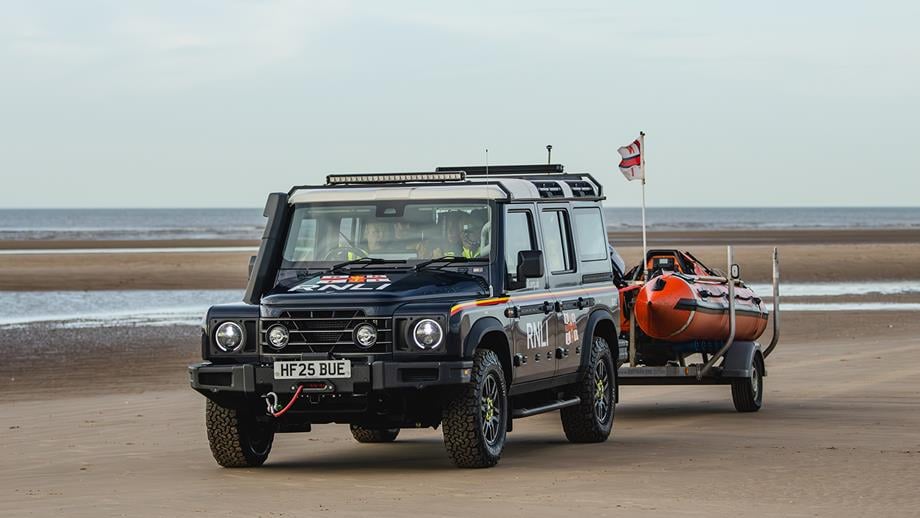
Day or night, rain or shine, RNLI lifeboat crews go to rescue no matter the conditions or time of day. That’s why tough, reliable equipment is essential in helping them launch as quickly and safely as possible. Find out how the INEOS Grenadier is already making an incredible difference to launches at some of our lifeboat stations.
In July 2024, the RNLI and INEOS Automotive announced an exciting 5-year partnership, which will see the INEOS Grenadier becoming the official vehicle of RNLI lifeboats.
INEOS will kindly provide 20 Grenadier vehicles to the RNLI over the duration of the partnership, which will be introduced at some of our lifeboat stations around the UK and Ireland. The rollout will be gradual, with INEOS providing four vehicles per year for 5 years.
Now over a year into the partnership, some of our crews have already started using the Grenadier to launch their lifeboats to the rescue – such as at Morecambe, Flint and Lytham St Annes. By the end of 2026, there will be 12 Grenadier vehicles at lifeboat stations helping to save lives.
The Grenadier will replace the Land Rover launch vehicles at the stations they’re deployed at, as part of the RNLI’s mission to modernise our lifesaving service and help make it fit for the future. Some of the crews receiving a Grenadier regularly launch their lifeboat on tricky terrains or from hard-to-reach locations – its rugged design and modern features will help make launches even quicker and easier for them.
The Grenadier’s main role is to position, launch and recover D class lifeboats – a versatile inshore lifeboat that can handle shallow water and rescues close to cliffs, rocks and caves. From transporting the crew and the lifeboat to the launching site, to providing a place to stow vital lifesaving kit, the Grenadier is involved in all key aspects of a lifeboat launch.
Crews often face salty, sandy and rocky conditions when launching their D class lifeboats, which is why their launch equipment needs to be just as tough and robust. Just like the D class, the Grenadier is manoeuvrable and versatile, offering great off-road capability and tough enough to handle challenging conditions and terrains.
Introducing a new vehicle to the RNLI fleet, especially one with advanced, high-tech capabilities like the Grenadier, meant that testing and training was vital.
RNLI engineering teams at the All-weather Lifeboat Centre in Poole were keen to see how the Grenadier performed. ‘We looked at operational parameters like navigating on challenging terrain, self-recovery with a winch, and towing a lifeboat on a slipway,’ says RNLI Engineer Sam Barton.
‘The second phase of testing took place on the coast, where we were looking to see how our volunteer crews responded to the vehicle – in particular its ease of use, comfort and operational capability in a beach environment,’ explains Sam.
Fleet mechanics and machinery trainers were on hand to give volunteers an in-depth breakdown of how the Grenadier works and how to operate it. This helped ensure they were able to use it effectively and safely – which is essential when time is of the essence during a rescue.
Our fleet operations teams were responsible for managing the coastal trials and gathering feedback from volunteers, including things they found useful and potential areas for improvement.
After coastal trials, our lifeboat crews and engineering teams were pleased with how easy the Grenadier was to use, as well as its many modern features – from built-in side steps for easier boarding, to the raised air intake for improved engine breathing.
They were also impressed with its supreme comfort and durability. For example, it has a corrosion-resistant paint finish that can cope with repeat exposure to saltwater, so it’ll be easy to maintain for years to come. And the automatic gearbox allows crew members to focus on getting to the launching site, without needing to change gears when driving over sand and through water.
Our engineers used feedback from crew members to create a final vehicle specification that met the needs of demanding rescues. ‘While the Grenadier already came equipped with several useful features, we added a larger winch to support self-recovery, and roof-mounted LED light bars for better visibility when launching into darkness,’ says Sam.
For a few months now, the crew at Lytham St Annes Lifeboat Station have been using the Grenadier for their launches.
The lifeboat station is close to both the River Ribble and Central Beach in Lytham, so a launch vehicle that can handle all types of terrain is vital for them. For example, when the tide is out at the beach, the crew have to drive 1.5 miles on wet sand to reach the water.
We asked two Lytham St Annes crew members, James Stannard and Tony Eaton, how they’ve found using the Grenadier so far.
Two of the biggest benefits they’ve found with the Grenadier is its power and grip. ‘The Grenadier is immensely powerful, while still being really smooth to drive. On the road and through sand, shale and mud, there’s still a lot of grip,’ says Tony.
‘It’s a very capable vehicle. The power of the Grenadier and its automatic gearbox mean we can focus on the launch and recovery, knowing it will be able to handle any terrain,’ explains James.
‘The modified winch is also really powerful and easy to use,’ adds Tony.
RNLI crews like at Lytham St Annes are ready to launch 24 hours a day, 7 days a week. That means launching into everything from sunshine and storms, to daylight and darkness. So they need to be prepared to face any conditions at any time of day.
The roof-mounted LED light bars were easy to integrate with the Grenadier's electrical system. They have helped make launches into darkness much easier and safer, providing great all-round visibility. 'The lights are excellent. With the light bars, it's just as easy to see where we're going at night as it is during the day,' says Tony.
James and Tony – along with the whole Lytham St Annes crew – also love how comfortable the Grenadier is. ‘As well as having a smooth drive, features like the high-quality heating and air conditioning system keep us comfortable. It’s been very welcome and much needed after long shouts,’ says James.
Tony adds: ‘After training and shouts in bad weather, the heating system has helped warm everyone up when we’re all wet and cold! It even has a de-mist feature, which has helped reduce condensation on windows after getting back into a warm vehicle wearing wet kit.’
With calls for help continuing around our coasts – and more crews set to use the Grenadier over the coming years – this latest addition to our launch vehicle fleet is going to make a lifesaving difference.


