 Donate now
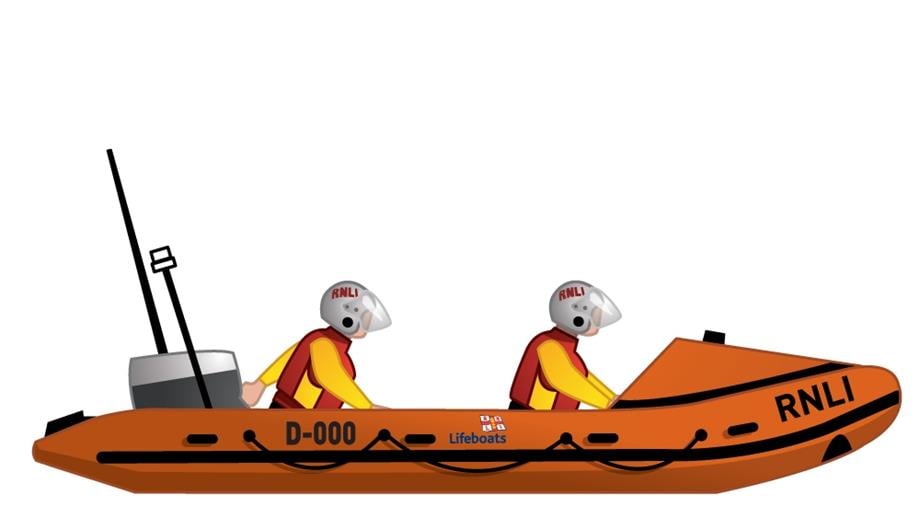
D class lifeboat

First introduced into the RNLI fleet in 1963, the design of the inflatable D class lifeboat continues to evolve to meet changes in demand and technology.
She is highly manoeuvrable and usually operates closer to shore than our all-weather lifeboats. She comes into her own for searches and rescues in the surf, shallow water and confined locations - often around cliffs, rocks and caves.

The D class is the best boat in the fleet in my opinion. She’s an understated pocket rocket.Damien BoltonHelm, Port Isaac RNLI
Speed
With a top speed of 25 knots, our D class lifeboat can endure 3 hours at sea at this speed on search and rescue missions – a crucial factor when lives at risk.
Manoeuvrability
Not only that, she can access areas inaccessible to our all-weather lifeboats, such as close to cliffs, rocks and caves.
As an inflatable inshore lifeboat, the D class is designed to operate close to shore in shallower water.
She is ideal for rescues in fair to moderate conditions and particularly in big surf.
Most D class lifeboats are launched from a trolley, with the help of a launch and recovery vehicle such as a tractor. They can also be lowered into the sea using a davit system (a shore-mounted crane).
Safety
With no wheelhouse on the D class lifeboat, the crew are exposed to the elements at all times and rely on their protective kit to keep them safe and warm.
Many rescues take place at night and can involve being close to dangerous cliffs, manmade structures or caves.
In addition to night vision equipment, the D class lifeboat carries a searchlight and parachute illuminating flares to light up the surrounding area, helping to keep crew members safe as well as locate those in need of help.
Medical equipment is stowed in the bow pod and includes oxygen and full resuscitation kit, responder bag and multi-purpose ambulance pouch.
In the event of a capsize, the D class lifeboat can be righted manually by the crew and her 50hp outboard engine restarted.
Efficiency and effectiveness
With over 60 years’ service, our D class lifeboat has helped us to save thousands of lives at sea and continues to be the workhorse of the RNLI fleet today.
Since she joined the fleet in 1963, her design has evolved to meet the changing needs of our search and rescue service. The latest generation of D class lifeboats, known as the IB1 type, was introduced in 2003 with improved speed, manoeuvrability and equipment.
All D class lifeboats are built and maintained at our Inshore Lifeboat Centre at East Cowes on the Isle of Wight.
Lifeboat category:
Inshore
Year introduced to the RNLI fleet:
1963 – her design has continued to evolve ever since
Latest design:
IB1 type introduced in 2003
Launch type:
Trolley or davit
Crew:
3-4
Survivor capacity:
5
Maximum speed:
25 knots
Range / endurance:
3 hours at maximum speed
Length:
5m
Beam / width:
2m
Draught / depth:
0.52m
Displacement / weight:
500kg
Fuel capacity:
68 litres
Engines:
1 x Mariner 3-cylinder 2-stroke 0.7 litre 50hp outboard petrol engine
Construction:
Hypalon-coated polyester
Number in fleet:
Currently 184 in total, 144 at stations, 7 in training fleet and 33 in build or repair
Identification
All lifeboats have a unique identification number.
The first part indicates the class so D class lifeboats start with D.
The numbers after the dash refer to the build number. So the first D class built in the current IB1 design was given the number D-600.
Communications and navigation
Includes:
- fitted and hand-held VHF (very high frequency) radio
- magnetic compass
- onboard global positioning system (GPS) plotter.
Watch our D class lifeboat in action
Key features

Systems and information Management system
Righting and restarting

Navigation and communication