

Find out some of the many benefits you gain when you decide to become an RNLI beach lifeguard saving lives on the beach.
Explore the benefits
 Donate now
Find out what requirements you need to meet to become an RNLI lifeguard, including qualifications and fitness.
In order to qualify to become an RNLI lifeguard, you will need to meet the below requirements. Don't worry if you don't quite match them yet. Further down the page, you will find help and advice on how you can work to meet the requirements to join the team.
To qualify to become an RNLI beach lifeguard, you will need a National Vocational Beach Lifeguard Qualification (NVBLQ) to become a lifeguard.
An NVBLQ provides you with an introduction to all elements of beach lifeguard theory, cardiopulmonary resuscitation (CPR), first aid, pool skills and open water skills. It’s a physically demanding course and includes swimming to set times and lifting. The NVBLQ comprises of a variety of units that you must successfully pass to attain the qualification. The courses are at least 40 hours long and are followed by a practical assessment.
If you don’t already have a NVBLQ, you can take a course to get the qualification.
The RNLI organises NBVLQ courses specifically for people who want to work as RNLI lifeguards. Please check back here to see where and when the next courses are happening.
Contact: [email protected]
If there are no suitable RNLI courses near you, you can do the NVBLQ with one of the following bodies:
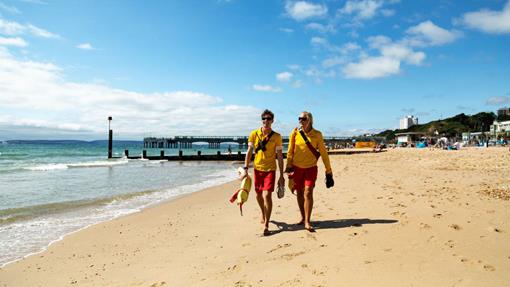
RNLI lifeguards are trained to think on their feet, to dynamically risk assess the situation, and to make split-second decisions
To keep you and others safe, we ask all our lifesavers to complete a health assessment and tell us about any medical conditions that may affect their ability to perform the role. This information allows us to support individuals appropriately and, where possible, consider reasonable adjustments.
During the recruitment process, you will be asked in confidence if you:
A lifeguard’s eyesight must allow them to safely and effectively perform the core duties of the role. The RNLI’s visual standard is based on three key principles:
1. Ability to identify a person who may need assistance.
Lifeguards must be able to visually scan the water and shoreline and clearly identify people who may be in difficulty. This includes recognising body position, movement, distress signals, or changes in behaviour at distance, in varying environmental conditions such as glare, surf, weather, and crowd density. Visual aids (such as glasses or contact lenses) may be used for this purpose where required.
2. Ability to reach the individual unaided.
Once a potential casualty has been identified, lifeguards must be able to safely and effectively reach them without reliance on visual aids. This includes maintaining visual awareness while swimming, wading, or moving through the surf to locate, approach, and secure the casualty. Where corrective eyewear is required, it must be suitable for use in the water if necessary.
3. Ability to maintain personal safety and communicate during a rescue.
Lifeguards must be able to maintain their own safety throughout a rescue by being able to communicate with colleagues on the shoreline or recognise visual signals from the shore. This includes seeing hand signals, flags, or other agreed visual cues, and maintaining situational awareness of hazards, other water users, and rescue support.
Functional testing is used to determine the ability of lifeguards who wear glasses or contact lenses to carry out their duties.
We do offer other opportunities on the beach with fewer medical screening standards, if you feel the role of an RNLI lifeguard may not be the right one for you. Please consider roles such as Lifeguard Support, Operations Assistant (Lifeguards) or those within our Face-to-Face Fundraising Team.
If you’d like to talk to someone in more depth about our health screening policy prior to application, please contact our People Department in confidence at [email protected].
Getting yourself fit enough to qualify to become an RNLI lifeguard can be a great way to improve your health and personal fitness. Here are some quick tips to help you with your preparations:
Look at the areas you need to work on and set up a plan on how you are going to train to reach the requirements. This could be setting up regular trips to the pool to practise your swimming skills, or regular runs to improve your general fitness and stamina. Make sure you balance exercise with giving your body time to rest and recover. Pushing too hard too soon can cause injury, setting you back in your preparations.
The best advice you can get for your preparations is from those who have already became RNLI lifeguards. Contact your local lifeguard team and see if they can help you with your physical preparations. They may run some training exercises during the off season to help you get up to speed, or be able to connect you with active lifeguards who can offer their guidance. Surf lifesaving clubs also cover a lot of the same activities that RNLI lifeguards do, and it can be a fun and social way to get yourself up to speed with the techniques needed to be a lifeguard.
The lifeguard seasons runs regularly across the year, with variations based on location and geography. So you should be able to find out when the seasons starts at the beaches you would like to patrol. That means you can give yourself a set schedule to work towards being ready before patrols begin. It might be that you don't have enough time to qualify for this year's patrol. In that case, you can look towards being ready for the following year's patrols.
RNLI lifeguards are always happy to speak with potential recruits. Next time you're at a lifeguarded beach, why not speak to one of the team and ask them about the role?
When I first looked at the fitness requirements, I thought there was no way that I could do the swim test. You have to complete a 400m pool swim in under 7½ minutes, and the first 200m must be completed in under 3½ minutes. It’s actually quite easy when you’re a competent swimmer, but at first it took me 9 or 10 minutes! I had a few coaching sessions with the RNLI which helped to improve my swimming technique.
As a surfer, I used to drag myself through the water with my upper body, so I didn’t have the best leg-kicking technique. The RNLI put on a few training courses in their sea survival pool for free, which I went to in the evening. I also met someone there in a similar position to me and we encouraged each other to improve. I realised that you don’t have to have a stereotypical swimmer’s body; swimmers are all shapes and sizes. Anyone can do the job as long as they are relatively fit and able to pass the selection tests.
Apart from the age, qualification and fitness requirements, anyone can be an RNLI lifeguard. We have lifeguards patrolling beaches from all types of backgrounds. You don't need to have grown up by the sea or spend your evenings surfing to be eligible. As long as you have the dedication, determination and the desire to help make beaches safer, you can be a part of our team on the beach.
Our staff and volunteers have been saving lives at sea without prejudice for nearly 200 years. We respect and value diversity of background, skills and perspectives within our teams, and consider it essential to help us deliver a world-class lifesaving service. We are an inclusive organisation and welcome applications from everyone. In addition to having the skills needed for the role, we also look for applicants who share our commitment to living our RNLI values (trustworthy, courageous, selfless, and dependable), and helping us work towards Our Vision: To save Every One.


If you are heading to the coast, choose a lifeguarded beach. Find the nearest one you so you can stay safe and have fun at the coast this summer.