


Since 2001, RNLI beach lifeguards have been working hard to keep you and your family safe at the seaside
Explore our history
 Donate now

RNLI lifeguards keep beachgoers safe by educating them about water safety and spotting dangers before accidents happen. When someone does find themself in peril, the lifeguards’ world-class training pays off.
The charity’s lifeguards have been patrolling beaches around the UK and Channel Islands for 25 years. Around 95% of their work is about preventing incidents before they arise, as demonstrated by the 2.6M preventative actions they took in 2025. Today, RNLI lifeguards keep watch at 238 beaches. Here are just some of the ways in which they’ve made a lifesaving difference.
Nine times out of ten, when swimmers wave from the sea, they're waving at family or friends on shore. But not this time. People were swimming and bodyboarding off Chapel Porth Beach in Cornwall. And one of them was waving. Through his binoculars, RNLI lifeguard Josh saw the look of panic on the face of the person in distress, who was about 50m from the shore. There was someone else with him too, splashing and struggling in the water, and both swimmers were getting dragged out by a rip current. 'They got sucked out, very, very quickly,’ says Josh. ‘I just went straight out.'
Three days into a family holiday at Fistral Beach, Cornwall, Richard’s vacation took a terrifying turn. ‘I was helping my daughters catch a few waves in the lifeguarded area of the beach,’ recalls Richard. After a while I walked to the dunes where we’d set up camp. Chatting to my wife, Tracey, as I untangled myself from my wetsuit, I suddenly felt extraordinarily light-headed.’ At that moment, Richard’s memory goes blank. Tracey turned to find him collapsed on the sand. And quickly realised something was seriously wrong. ‘His eyes were wide open and he was trying to catch his breath,’ says Tracey. Onlookers waved frantically at the lifeguards to get their attention.
‘He fell unconscious and stopped breathing,’ Tracey remembers. ‘The lifeguards came running full pelt towards us, with their kit. I stood back and watched as one lifeguard did chest compressions and another used the defibrillator on Richard. It all happened so fast.’ Thanks to the quick-thinking lifeguards, Richard regained consciousness in minutes. But the drama wasn’t over. When the ambulance arrived, Richard was taken to hospital, where he learned he’d suffered a cardiac arrest. In hospital, the physicians were very clear – the speed of the lifeguards had saved Richard’s life. He would need major surgery, but because the lifeguards had acted promptly, his heart was undamaged, and he would likely make a full recovery.
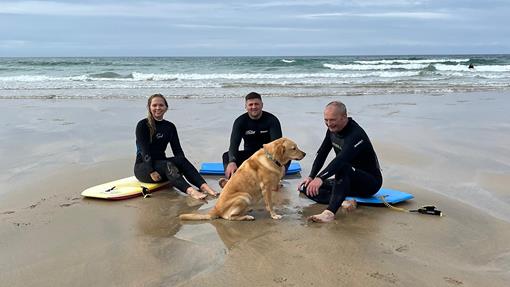
If it wasn’t for those lifeguards I might not be here. I’m incredibly grateful.
‘We were in a restaurant and there was only us and another family, that was it. We had just sat down to eat, and then we heard someone coughing behind us,’ recalls RNLI lifeguard Lauren Cooke, casting her mind back to a holiday in Crete. ‘We turned around and this man had his baby over his arm, so I knew the baby must have been choking. We went over to see if there was anything we could do, and the guy handed me the baby.’
A choking baby is a different matter to a choking adult or older child. Their fragile bodies mean you need to know the exact amount of force to use so you don’t cause severe damage while clearing the obstruction. And when a baby is turning blue from lack of oxygen, it’s easy to panic. But Lauren’s casualty care training meant she knew exactly what to do. ‘I performed five slaps on his back and one chest thrust. Thankfully this dislodged the food from his windpipe and he started breathing again.’ The baby quickly regained his normal colour, much to his parents’ relief. ‘They were so grateful,’ says Lauren.
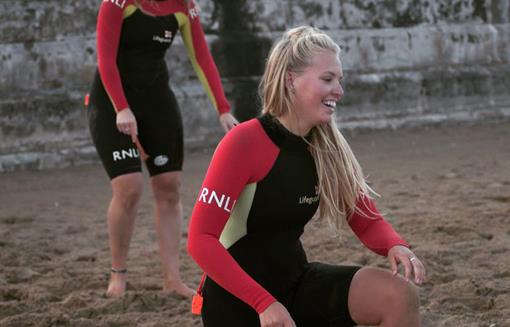
This man had his baby over his arm, so I knew the baby must have been choking.
It was May half-term holiday. At low tide, Lifeguard Supervisor Gary Sinkevicius was on patrol in Croyde, Devon. ‘A mid- to low tide at Croyde is more dangerous,’ Gary explains. ‘There are deep holes and rip currents.’ Suddenly, a boy ran up to Gary. The boy’s dad was bodyboarding, while his mum, brother and sister stayed on the beach. The brother and sister had gone to play in rock pools, far from their mum. They’d jumped in, but strong currents swept them off their feet. They were sucked out to where big waves were breaking. ‘I ran the 300m to the water with my rescue board,’ Gary recalls. ‘I jumped into the rip.'
‘I thought the girl was unconscious to begin with – I thought she was about to give up and go under. I pulled her onto the board. The girl jumped on top of me and cuddled me like a koala bear. She was terrified. I was trying to paddle back as the boy hung onto my board. Suddenly, a wave washed us all onto a sandbank. The kids were being sick. I thought they might have inhaled water. “Call 999 – we need an air ambulance,” I said.’
Both children were blue and pale. Gary took them back to the beach, where waiting ambulances transferred them to an air ambulance. Gary reports that both children recovered. ‘The girl was admitted to A&E with water in her lung but was out the next day.’
On a busy July day, Dan Pearson was one of four RNLI lifeguards on patrol at Langland Beach, Swansea. Lifeguard Supervisor Tom John assisted the team in anticipation of a busy day ahead. By 5pm, the conditions had changed. ‘The sea suddenly looked like what you’d expect in winter,’ Tom recalls. ‘We put the red flags up, and most people got out of the water. But we spotted a woman entering the sea, outside of our flagged zone. We could see the exact moment she got into difficulty,’ Tom explains. ‘She started doing funny swimming strokes, and that’s all the evidence we need. She was in real trouble.’
Dan ran into the water with a rescue tube, with Tom swiftly behind him with his rescue board. ‘When we got to the swimmer, she had pretty much given up. Her hair was over her face, she was low in the water … if we hadn’t reached her when we did, she wouldn’t have lasted much longer,’ Tom says. The swimmer was exhausted and unable to speak. Tom supported her with his board while Dan wrapped the rescue tube around her. Dan explains: ‘All you’re thinking is: “Get her out!”’ ‘When we were shallow enough, I helped Dan carry her to shore,’ Tom says. ‘She started to become more responsive,’ he remembers. ‘She said she was giving up out there – she didn’t have much left.’
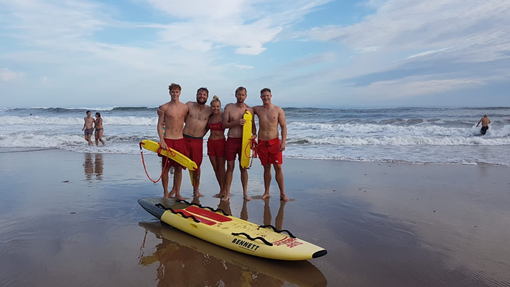
She started doing funny swimming strokes, and that’s all the evidence we need. She was in real trouble.

Since 2001, RNLI beach lifeguards have been working hard to keep you and your family safe at the seaside


If you are heading to the coast, choose a lifeguarded beach. Find the nearest one you so you can stay safe and have fun at the coast this summer.