




Heritage
 Donate now

At 7.45pm on 18 October 1939, Whitby RNLI launched their lifeboat into dark and choppy seas to search for survivors after reports of a vessel firing signals. After a fruitless search, the crew returned empty handed. But nearly 9 decades later, Carolin Hochstuhl recounts her grandfather’s tale of survival that night –and how her family will always be connected to Whitby’s shores.
For over 200 years, RNLI volunteers have been ready to drop everything at a moment’s notice to save lives at sea. During wartime this was no different, though lifeboat rescues now posed more peril and new complications, like navigating live mines and enemy gunfire.
In October 1939, the Second World War had only just begun when Whitby Lifeboat Station received a request from the Coastguard. They’d been tasked to search for survivors after signals were sighted firing from a vessel roughly 6 miles north of Whitby.
After hours of searching in the dark, with nothing found, the lifeboat crew returned empty handed. Reading the service return for this shout, you might think this RNLI story ends there: a failed mission or false call with good intent. But that couldn’t be further from the truth.
Carolin Hochstuhl’s grandfather, Bernhard, from a small village at the foot of the Black Forest near Baden-Baden in Germany, was a young man in his early 20s with a passion for flying. Keen to pursue this skill, he joined the Luftwaffe (the German Airforce at the time) so that he could live out his dreams of flying planes. But one of his first missions, a reconnaissance flight to Britain, almost ended in complete disaster.
On the afternoon of 17 October, Bernhard and his crew were flying towards the Forth of Clyde in Scotland. Bernhard was the radio operator and navigator for this flight. During their journey northwards, they were spotted by the RAF. The RAF quickly called upon their pilots from the Green Section to take off and investigate the unidentified aircraft.
Pilot Ted Shipman, also on his first ever mission of the war, quickly located Bernhard’s Heinkel with his crew mates, Blatchford and Harris. After an exchange of gunfire in both directions, it was Shipman who emerged victorious. In his memoirs, collated together in John Shipman's book One of 'The Few’, Ted recalls this rather regretfully:
‘This first sighting, encounter and shooting down of an enemy aircraft caused some very mixed feelings. First there was a feeling of regret that an enemy had been sited at all, and then the immediate realisation of the inevitability of the situation. The attack had to be pressed home once identification at close quarters had been made or the risk of being shot down first was real enough. On the whole I cannot say I was elated.’*
Shipman and his crew watched the Heinkel ditch in the sea and saw two crew emerge into a rubber dinghy before the plane sank. Blatchford radioed the position of the airmen with the hopes that a rescue boat would be launched to collect them, before heading back to camp. But the airmen’s position was never received, and so began a tremendous ordeal for Bernhard and his only surviving crew member, Eugen, in the bitter North Sea.
The signals that caused Whitby’s lifeboat Mary Ann Hepworth, under the command of Coxswain Murfield, to launch on 18 October were calls for help from Bernhard – who had already spent an entire night and day at sea, paddling in freezing cold waters with only his hands to keep the dinghy steady. As their dinghy was damaged and rapidly deflating, Bernhard and Eugen also had to keep blowing air into it to stay afloat. Had the RNLI found Bernhard that night, they would have rescued him the same as any British soldier.
Sir William Hillary’s resolution at the RNLI’s foundation that: ‘… the subjects of all nations be equally objects of the Institution, as well in war as in peace’ remained strong throughout wartime, and RNLI lifeboats rescued casualties from all nations, including Germany.
But despite their best efforts, the crew at Whitby returned empty handed. It was not until the morning of 19 October that a favourable tide miraculously washed the pair from the Luftwaffe ashore at Sandsend, under the cliffs at Sandsend Wyke. This was another disappointment for Shipman, who had ended his mission certain the men he’d shot down would be saved and that he could even pay them a visit:
‘Although we were told that the German survivors were being picked up, for some reason this was found not to be true, for they came ashore at Sandsend some forty-eight hours later […] I asked to go and see them and to take some cigarettes and chocolates for them, but I was refused this wish, which I thought to be quite reasonable. This made me feel even worse than I did when I found that we had been let down over the promised pick-up.’*
And so, exhausted, with shrapnel embedded in his leg, and his crew mate barely conscious on the shores below, Bernhard scaled the cliffs at Sandsend alone in search of aid.
Here, he was discovered by an extremely surprised LNER Special Constable, George Thomas, who was guarding the railway tunnel from would-be saboteurs.
In broken English, Bernhard tried to convey the precarious position of his friend below. After a lot of confusion, Thomas finally understood and was able to recruit Jack Barker, the Lythe Duty Police Constable, and Frank Dring, a local painter, to help retrieve the other unconscious pilot using the deflated rescue dinghy as a stretcher. This was no mean feat, as the track they had to follow was hazardous and steep.
Bernhard and Eugen were escorted to to Sandsend Railway Station, where they were given a cup of tea by the station master to revive them, before spending the night at Whitby Police Station.
As a token of his gratitude, Bernhard gave Thomas a packet of cigarettes, reportedly saying: ‘I don’t know what we’re fighting for. I shall not smoke these cigarettes – but I may have one when there is somebody else in charge in Germany and peace is declared’.
Carolin, Bernhard’s granddaughter, acknowledges that Bernhard and Shipman were young men thrust into circumstances beyond their control. After the help he received at Whitby, she explains how Bernhard remembered Whitby fondly, and that ‘he didn’t think of these people as his enemies, but as his rescuers’.
In due course, Bernhard and Eugen were transported to London – becoming the first ever prisoners of war captured on English soil during the Second World War.
The experience left a lasting impression on Bernhard who ‘always thought of this day as his second birthday’, Carolin explains. Bernhard was given a second chance at life after surviving the impossible. 40 years later, in 1979, he returned to Whitby to meet and thank the people who rescued him. This story was later retold in FlyPast Magazine.
For Carolin, learning about her grandfather’s past was a way to get closer to him, and to understand her own place in the world. She says: ‘If you miss people in your family, you begin to investigate what was important to them and what was their story. I grew to understand that I wouldn’t be here if my grandfather didn’t survive and if these people hadn’t helped him’.
And so, another 45 years on from Bernhard’s visit, in 2024, Carolin and her family made the trip from Germany to Whitby, to see for themselves the site of her grandfather’s tremendous ordeal. Carolin and her brother, Benedikt Hochstuhl, planned this trip meticulously. She says: ‘Our father told us all about our grandfather’s story, so we wanted to visit Whitby and see where it all happened. Sadly, our father died half a year before we could do the trip. So we did it without him, but in his memory. That was very moving for us.’
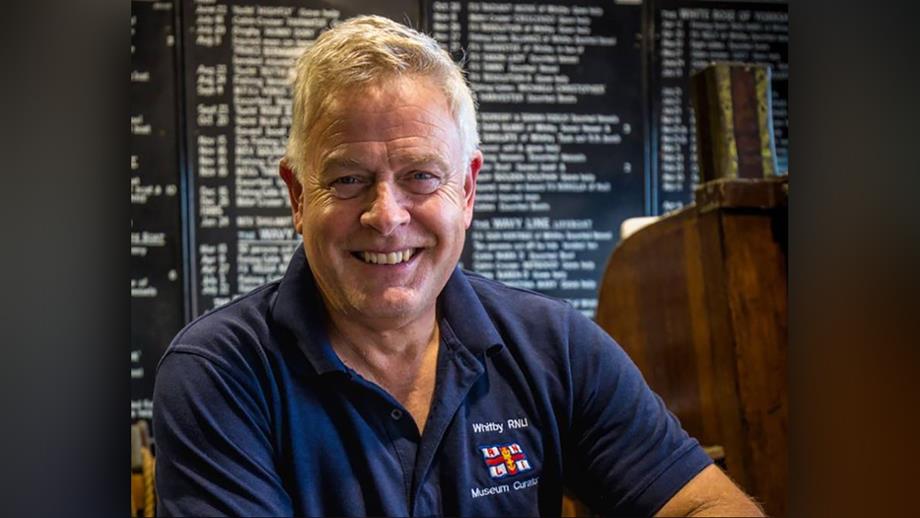
Carolin had no idea that her grandfather had been searched for by the RNLI – it was purely by chance that during their holiday they stumbled across Whitby Lifeboat Museum and, even more fortunately, its Volunteer Curator, Neil Williamson.
Carolin recalls: ‘First, we just thought, let's go to Whitby and we can walk along the coast and experience the landscape and the environment. Then we found the Lifeboat Museum and thought: “why don’t we go in and see if they know anything more about Bernhard?” They were so friendly and helpful, and it was such a lovely experience. They were also very interested in the story – that was lovely for us.’
Neil was able to do further research and discovered photos of Bernhard and Eugen in London, as well as of Ted Shipman, which he shared with Carolin and her family.
Neil says: ‘It's always great to meet visitors who are searching for information about rescues or events from the past. Carolin’s visit opened up a whole new area of research for the museum. I was so pleased that our archive could fill in the missing gaps in the family's research.'
The RNLI didn’t manage to find Carolin’s grandfather that night in 1939. But, two generations later, Carolin found the RNLI – and with it, finally connected two halves of a story that had remained a mystery to each other for 85 years.
*Extract from One of 'the Few': The Memoirs of Wing Commander Ted 'Shippy' Shipman AFC by John Shipman. Published by Pen & Sword Aviation, 2008.


