


People
 Donate now

If you’re reading this article, there’s a very good chance you’re already familiar with the RNLI’s lifesaving work across the UK and Ireland. But did you know that a small yet notable percentage of our crews’ daring rescues involve animals?
If you weren’t aware that RNLI lifesaving extends to our furry, feathered, and scaly friends, it might come as a surprise to you that out of 9,058 total lifeboat launches in 2025, 179 were to animals.
Even though records of RNLI animal rescues only began in 2010, we thought it would be interesting to dig into the numbers.
In the past 16 years, the RNLI has rescued a total of 2,392 animals. Some are more surprising than others…
Given that many of us enjoy taking our dogs on coastal walks or for a stroll along the river, it’s perhaps no surprise that a whopping 86% of animal rescues were man’s best friend.
Interestingly, three stations have seen more than the average number of dog rescues. These are Chiswick, Littlehampton and Queensferry.
After dogs, we have the slightly more surprising whale. While you might wonder why a whale would need rescuing from its natural habitat, it’s not uncommon for them to become entangled in nets and fishing gear and need help.
On 16 November 2011, the all-weather lifeboat at Dunbar launched in support of British Divers Marine Life Rescue, as they attempted to cut free a 12m whale which had become entangled in fishing gear off the harbour.
And in 2013, the Irish Coast Guard alerted Tramore Lifeboat Station to a whale tangled in lobster pot ropes. With assistance, the crew managed to cut the rope and set the whale free unharmed. It was later identified as a Minke whale.
Sheep are the third most rescued animal, with a grand total of 45 rescues since 2010. One such rescue happened earlier this year, when the crew at Angle RNLI were called to provide cover to members of the public attempting to help two sheep stuck at the base of the cliffs at Elegug Stacks in Pembrokeshire.
On the lower end of the rescue tally, we have animals like badgers (one), ponies (two) and foxes (four), as well as birds such as pheasants (one), geese (two) and swans (eight).
Animals with higher rescue counts include deer (22), seals (31) and dolphins (44).
As well as the larger animals already mentioned, RNLI crews have also rescued cows, horses and bulls. But we often get asked about our smaller four-legged friends. So, would the RNLI rescue a rabbit? Since our records began, this hasn’t happened, but that’s not to say that it couldn’t.
Over the years, RNLI crews have rescued two ferrets, showing that even the smallest members of the animal kingdom are worthy of a helping hand.
Here’s where the data gets interesting. When the total number of animal rescues is broken down, there is a clear top three when it comes to which lifeboat stations have been called out to help the most animals: Chiswick (71), Littlehampton (56) and Queensferry (52).
Given dogs make up an overwhelmingly large percentage of animal rescues, let’s take them out of the mix to get a broader view. Our top three stations now become:
Gravesend has been called to an unusual array of animals, including seals, swans, and even a seagull! The seagull had become tangled in a fishing line but thankfully was safely rescued.

2,392 animals rescued since 2010

2,046 dogs rescued

Chiswick rescued 3% of all animals
Lifeboat crews are trained and equipped to respond to emergencies at sea and along the coast, 24/7. Over the years, they have rescued a wide variety of animals when they’ve been stranded in the water or in danger on the coastline.
For example, there have been cases where RNLI crews have headed into choppy coastal waters to rescue stranded dogs and reunite them with their worried owners.
Rescuing animals comes with its own unique risks and challenges. Crews can never know how an animal will react when they're on scene and, naturally, communication is an issue!
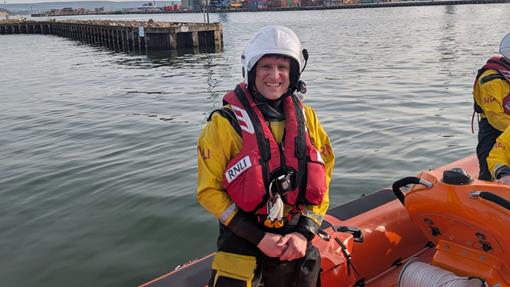
Our top priority is ensuring members of the public don't try to step in and put themselves in danger in the process
Steve Nelson, Crew Member at Poole Lifeboat Station, says: ‘We do our best to keep the animal calm, while making sure we're as protected as possible, with gloves on and our visors down. It's important to make sure that the owners are kept calm and safe, especially as it will be an upsetting situation for them. Ultimately, while we obviously want to help animals in distress, our top priority is ensuring members of the public don't try to step in and put themselves in danger in the process.’
As an organisation, the RNLI also works to educate the public about coastal and water safety, including the risks related to wildlife and animals at the coast.
Earlier this year, in Devon, a dog fell from the coastal path onto the rocks below after being spooked by another dog. A shore-based Coastguard Rescue Team consulted with Ilfracombe RNLI lifeboat crew volunteers, and it was agreed that, because of the inaccessible location, the most effective rescue option was to launch Ilfracombe’s D class inshore lifeboat.
In challenging conditions, the crew manoeuvred the lifeboat as close as possible to the rocks, before a crew member carefully entered the water and swam to rescue the stranded dog.
After reaching the dog, the crew member secured it and swam back to the lifeboat. The dog was reunited with her very thankful owners shortly afterwards.
Here are our tips for staying safe while visiting the coast:
It’s not just our lifeboat crews working hard to save dogs. Last year, RNLI Lifeguard Elen Hill rescued Bertie, an adventurous Giant Schnauzer who swam more than 200m out to sea and began to tire. Thanks to Elen, Bertie was safely brought back to shore and reunited with his worried owners.

Cats may be famous for always landing on their feet and having nine lives, but even they can get into trouble in the water. Here are nine stories of cats being rescued by RNLI crews over the years, with an honourable mention to this eventful rescue.
Despite the cat’s reluctance to be rescued, he was safely brought back to dry land, where he was quickly chased off by a dog. Some days, a cat just can’t catch a break.
Donations from kind people like you power our lifesavers to the next rescue, whether it’s to a human, a dog, or even a reluctant cat! Thank you.


