


People
 Donate now

Your first shout as shore crew
Imagine you’re a newly qualified shore crew member and your pager goes off… what happens next?
Shore crew are volunteers and many work alongside volunteering for the RNLI. While they’re on duty, they will carry their pager with them and stay within range of their station. If they need time off, or to go further afield, they can sign off from duty online.
Now, imagine you’re newly qualified shore crew and you’ve just sat down with a cup of tea and your copy of Surviving the Storms…
Suddenly your pager goes off and flashes up the message ‘Launch ILB’ – that’s the most urgent type of launch: the boat needs to go immediately and there’s possibly someone in the water. You jump up, grab the pager and your keys, quickly slip on some shoes, and head out the door.
You get to the station, and you can see other crew are already here and more are arriving behind you. The station is open, and people are getting straight to their tasks. Another member of shore crew, who is qualified as a head launcher, was first through the door and is putting on the orange hi-vis jacket that shows they are in charge of the launch.
You change into your wellies and jacket and put on a lifejacket. While others get changed, and the head launcher and selected tractor driver check the rig, you collect the VHF radios for your team from their charging stations. Another member of shore crew has already asked the helm if they need the salvage pump and has helped to lift it onboard with another member of shore crew.
The rest of the shore crew are gathering at the briefing point, and the head launcher assigns roles. You have been assigned as a banksman or marshall - your role is to make sure the area around the launch is safe and free from hazards during the launch.
You head to your spot at the side of the slipway. You check your radio is on the correct channel and volume, and that you have your whistle. You make sure there is nothing in your area that could be a risk: no members of the public too close or dogs that aren’t on a lead. You signal to show the head launcher your area is safe to launch. The tractor beeps to indicate it will start moving and you keep checking that your area is still safe to proceed – getting ready to call an emergency stop if needed.
The rig and tractor clear the boathouse and stop on the slipway. The tractor driver puts their hands in the air to show they aren’t on the controls and it’s safer for people to move in front of the tractor.
The head launcher indicates you should fit the pin and strop. The pin stops the rig from accidentally disconnecting on land, and the strop keeps the tractor and rig connected but can unravel so you can put distance between the two.
The rest of the shore crew put one hand up to indicate the tractor should not move – this helps keep you safe. You step out from between the tractor and the rig, make eye contact with the tractor driver, and make the hand signal to indicate the pin and strop have been set. You then go back to your position. Once everyone is clear of the rig, the shore crew drop their raised hands and signal once they’re sure their areas are safe. The head launcher gives the tractor driver the signal to launch, the tractor beeps, and moves down the slipway until the rig is deep enough in the water for the Atlantic 85 lifeboat to start floating.
It’s been about 10 minutes since the pager went off.
Once the lifeboat is clear of the rig and underway, the tractor returns to the top of the slipway. The head launcher tells the tractor driver to turn off the engine and once that is done, indicates you can put the chocks (blocks to stop the wheels moving) in front of the rear wheels and reset the pin and strop. Another member of shore crew goes into the rig and throws any ropes to the outer side of the rig to make it easier for the boat crew to grab and secure the boat during recovery.
What happens next depends on the type of shout. You might need to provide extra help - for example, if the boat comes alongside at the quay. Today, it seems like it will be a relatively quick shout, so the head launcher asks you to prep for recovery. Between you, you unroll the hoses and lay them down either side of the slipway and fill two buckets with boat and environment-friendly soapy water. Someone opens one of the gates at the end of the rig to help the lifeboat reverse onto it. Two other shore crew go to the fuel store and bring back several cans of petrol.
Once word comes in that the lifeboat is on its way back, the process starts again. You are still a banksman and clear the area. The head launcher asks you to change the pin and strop, ready for the tractor to go into the water, and then remove the chocks. Once you’ve done that and given the hand signals to the tractor driver, you return to your spot and give the hand signal to the head launcher that your area is safe to proceed. The head launcher gives the signal to the tractor driver to head down the slipway.
The tractor driver carefully positions the rig at the right depth, and at an angle to the wind and current, to make it easier for the boat crew to reverse the lifeboat back into the rig. Once the boat is secure, the tractor driver brings the tractor back to the top of the slipway. The head launcher asks the driver to turn off the engine. Once the engine is off, you put the chocks back in front of the rear wheels and reset the pin and strop.
Now a flurry of cleaning starts! The shore crew member on the opposite side starts hosing down the outside of the boat and rig. You take one of the buckets filled with soapy water, sponges and a brush, and hand it up to the boat crew. You then take the hose on your side which has a special fitting that looks a bit like two sets of headphones – these are the muffs. You check with the helm that it's OK for you to enter the rig and put the muffs onto the engines – you position each muff ‘headphone’ over the engines’ intakes. You climb out the rig and switch the valve on the hose to on and let the helm know that you are clear and the water is running. The helm starts both engines and you watch to make sure that water comes out of both engines and is running clear. This flushes any salt water out of the engines. After a few minutes, the helm turns off the engines, and you can remove the muffs and put them away.
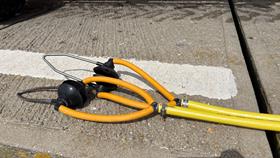
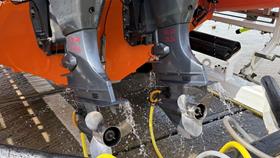
During this time, other shore crew have been using a brush and the other bucket of soapy water to clean the tractor before it gets rinsed off with the hose and the drive shaft boxes get a blast to make sure no sediment or sand is still in there. The hose is then passed to the boat crew to rinse off the inside of the boat. With all this activity going on at once, pay attention to the wind direction and who is hosing what, so you don’t get a face full of cold water!
Once the hose is back off the boat, drained and put away, everyone goes back to their positions and indicates to the head launcher their area is safe. The chocks are removed and the head launcher then instructs the tractor driver to dip the boat by taking it part way down the slipway. This is so all the water in the boat runs to the front and out through the drainage holes. Finally, the head launcher signals to the tractor driver to bring the boat all the way back into the boathouse.
Once the tractor and rig have stopped and the engine is off, you step forward to collect the empty bucket and mop from one of the lifeboat crew and put it away. With another member of shore crew to help, you are then passed down the salvage pump, which you put on a table and open up so it can air and let out any moisture. Meanwhile, another member of shore crew is collecting any VHF radios and taking them back to be put on charge. Other members of the shore crew have passed the fuel and refuelling kit to the boat crew and then return the empty cans to the fuel store. They make a note of how many cans were used and how many cans are left on a whiteboard in the boathouse.
Finally, you change back into your regular clothes and gather for the debrief. The helm explains the shout and gives feedback, while the deputy launch authority makes notes on the Return of Service form. The head launcher also gives feedback and runs through some key points with the Launch Authority for anyone to raise any issues: was everyone safe? Is everyone OK? Were there any equipment issues? How did everyone perform?
Once the debrief is finished, you say goodbye and head home to your book, wondering if your cup of tea is still warm.
If you’re inspired to help get our lifeboats launched, you can find out more about shore crew requirements or check if your local station has any open roles.
You can also help keep our shore crews warm, dry, and safe by making a donation which could help buy their next pair of boots.


